Read the Scripture.
The biblical text is the primary reference for the accounts discussed here. Read the complete chapters before comparing the guide's interpretation.
Begin with Ashur
Assyria developed in northern Mesopotamia, with the city of Ashur as a central religious and political reference point. Its history covers changing institutions and territories over many centuries. The Old, Middle and Neo-Assyrian labels are scholarly period divisions; they should not suggest that the same imperial boundaries existed throughout.
Trade before the great palaces
Old Assyrian merchants operating in Anatolia in the early second millennium BCE left written accounts of trade, credit, travel and family affairs. Their tablets illuminate the practical work behind long-distance exchange. They offer a useful counterweight to the much later royal monuments that dominate popular images of Assyria.
The imperial centuries
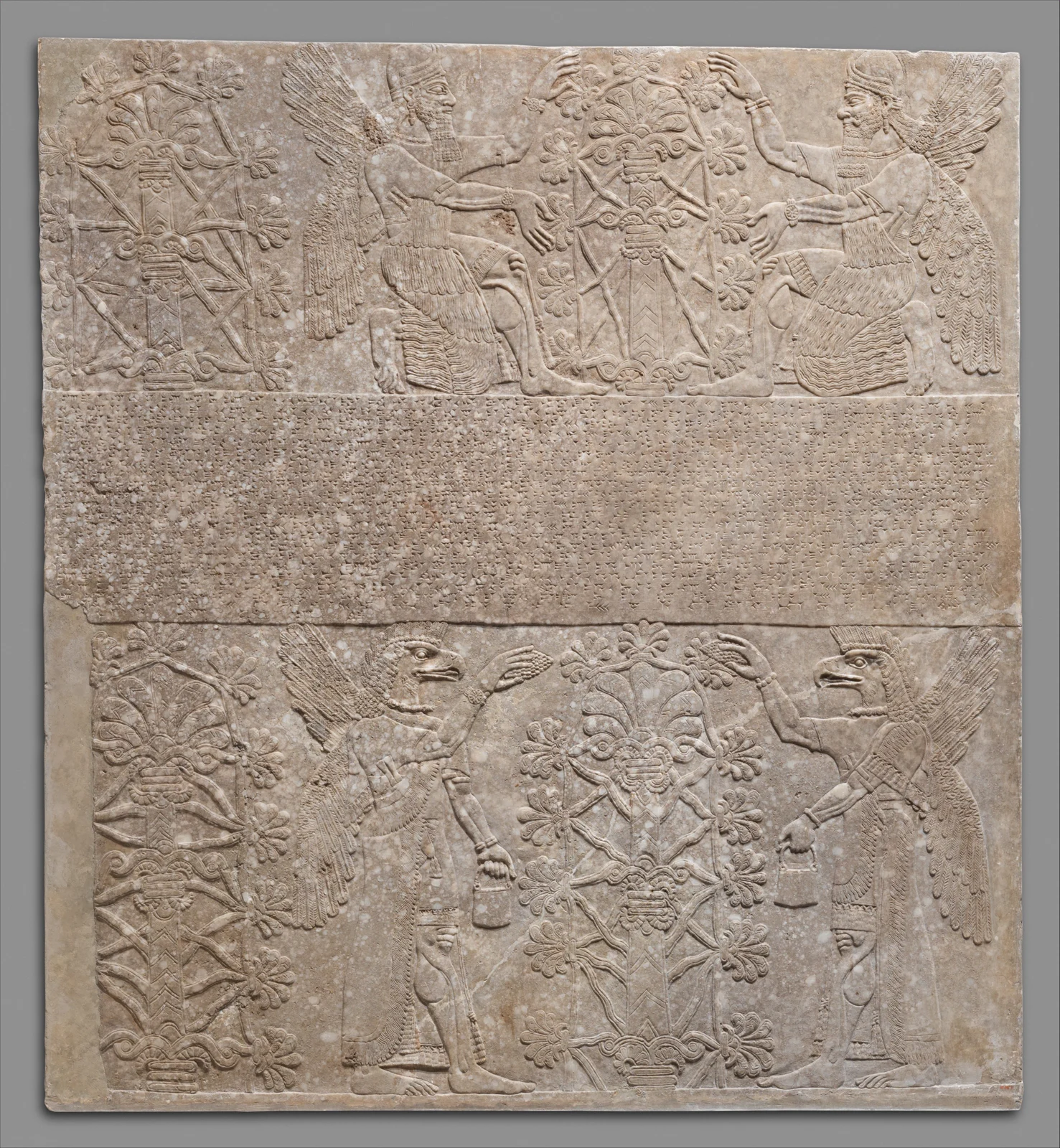
Assyria expanded in the Middle Assyrian period and again in the ninth to seventh centuries BCE. Rulers constructed major capitals at Kalhu, Dur-Sharrukin and Nineveh. Monumental art proclaimed royal authority, while inscriptions presented campaigns and building works in the king's preferred terms. These are important primary sources, but their political purpose matters when assessing what they tell us.
After the empire
The late seventh-century BCE collapse of Assyrian imperial power marks a political transformation. It should not be treated as proof that every local population or cultural practice disappeared. Ashur itself experienced later occupation, including a Parthian revival. Studying subsequent centuries requires their own evidence rather than filling the interval with assumptions.
A route through the archive
Read the city entries for geography, the trade article for everyday documents, and the art entries for visual interpretation. Keep a distinction between an artefact's ancient setting, its modern excavation and its later museum history. The full story includes all three.
From a city to a territorial kingdom
Ashur stood on the Tigris before Assyrian kings governed a much larger territory. Early second-millennium merchants linked the city to Anatolian settlements, carrying tin and textiles and arranging business through households. The later Middle Assyrian kingdom extended political control westwards into northern Mesopotamia. Provincial offices, agricultural estates and obligations of service sustained that larger state.
The Neo-Assyrian centuries brought another expansion of scale. Some conquered areas became provinces, while other rulers remained in place under tribute and loyalty obligations. Those arrangements differed in how directly officials intervened in local government. An imperial map therefore represents several relationships, rather than one identical form of rule everywhere.
Why the capitals changed
Ashur retained religious importance after the royal court moved elsewhere. Ashurnasirpal II developed Kalhu, now Nimrud; Sargon II built Dur-Sharrukin, now Khorsabad; and Sennacherib centred his court at Nineveh. Each capital required labour, materials, provisions and a supporting landscape.
Nineveh's fall in 612 BCE and the later defeat of remaining Assyrian resistance ended imperial supremacy. They did not erase every settlement or population in northern Mesopotamia. The subsequent history includes changing states, regional occupation, languages and religious institutions. Following those later developments explains both continuity and change without pretending that the palace administration survived intact.
This introduction draws on the following sources: [1][2][3][4][5][6][7]. Section reading trails highlight selected references where a more precise relationship has been recorded. Unmapped passages and other references remain at article level; these trails are not a sentence-by-sentence verification. Editorial guidance is identified in the text.
Sources & further reading
- 1Biblical primary source
Holy Bible: World English Bible British Edition with Deuterocanon
World English Bible translation project / eBible.org
Public-domain Bible wording; full retained text and local chapter references at /bible/. Recorded source check: 2026-10-26. - 2Institutional collection
Assyria, 1365-609 B.C.
The Metropolitan Museum of Art, Department of Ancient Near Eastern Art
Public resource; check individual reuse terms. Recorded source check: 2026-10-26. - 3Institutional collection
Cuneiform tablet: caravan account
The Metropolitan Museum of Art
Public resource; check individual reuse terms. Recorded source check: 2026-10-26. - 4Institutional collection
Ashur (Qal'at Sherqat)
UNESCO World Heritage Centre
Public resource; check individual reuse terms. Recorded source check: 2026-10-26. - 5Museum scholarship
The Assyrian Sculpture Court
Michael Seymour, The Metropolitan Museum of Art
Public resource; check individual reuse terms. Recorded source check: 2026-10-26. - 6Edited primary inscription corpus
Royal Inscriptions of the Neo-Assyrian Period (RINAP)
University of Pennsylvania / Open Richly Annotated Cuneiform Corpus (ORACC)
Public searchable editions of royal inscriptions; cited for historical context and independent records of royal claims, not as proof of every biblical or theological interpretation. Recorded source check: 2026-10-29. - 7Preserved encyclopaedia reference
Assyria
Wikipedia contributors
Full text retained locally under CC BY-SA 4.0. Recorded source check: 2026-10-25. Read retained copy
A foundation to build on
This introduction was compiled from the linked sources and has not received specialist peer review. It is intended as a route into further research. Read how corrections and reviews are handled.
Prepare a correction or contribution