Read the Scripture.
Genesis names Calah among the cities in its account of Nimrod and Assyria. The identification of ancient Kalhu with the archaeological site now called Nimrud comes from historical and archaeological evidence; the modern site name does not establish that Nimrod lived there.
A capital rebuilt
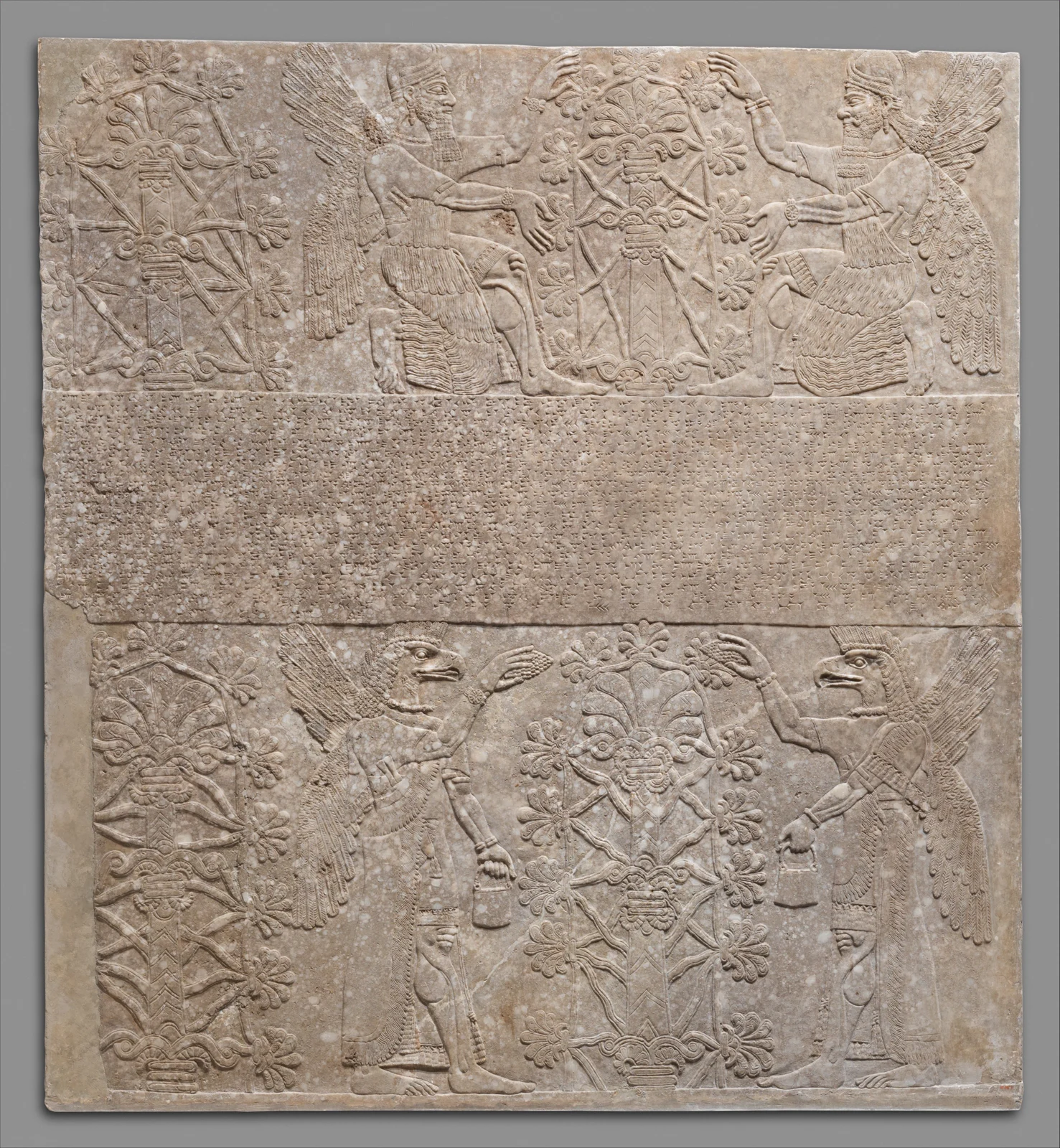
Ashurnasirpal II, who reigned approximately 883-859 BCE, made Kalhu a major royal capital. The site is widely known today as Nimrud. The palace sculptures now held in museums originally formed parts of architectural spaces, rather than independent pictures.
Reconstructing a setting
The Met's Assyrian Sculpture Court evokes a palace setting while explicitly acknowledging that it is not a full reconstruction. Its reliefs originated in multiple rooms. That distinction helps visitors separate a modern display from a securely known ancient arrangement.
Look closely
Observe changes in scale, repeated figures, patterned clothing and the relationship between carved imagery and inscriptions. Then ask where a panel stood and who could see it. Those contextual questions are as valuable as identifying the king or protective figure.
Kalhu as a working capital
Ashurnasirpal II transformed Kalhu into a major ninth-century BCE royal centre. The North-West Palace combined ceremonial display, controlled approaches and the needs of a court. Reliefs and monumental guardians were architectural elements encountered as visitors moved through its spaces.
The capital required stores, craft production, water and agricultural support. Transport and construction connected the palace to people and resources beyond its walls. Museum displays often privilege the carved decoration, but the city also depended on activities that left fewer spectacular objects. Royal art is one part of understanding how Kalhu functioned.
Ivories, tombs and the wider city
Excavations recovered carved ivories and objects associated with elite households and royal tombs as well as reliefs. Some ivories reflect artistic traditions outside Assyria, revealing the court's regional connections. An object found in an Assyrian palace was not necessarily made by a local workshop.
Kalhu is associated with the biblical Calah of Genesis 10. Nimrud is the later name commonly used for the site. Keeping those names together connects biblical geography, ancient urban history and archaeology without creating three separate cities. Findspots and building contexts then help explain where individual objects belonged.
This introduction draws on the following sources: [1][2][3][4]. Section reading trails highlight selected references where a more precise relationship has been recorded. Unmapped passages and other references remain at article level; these trails are not a sentence-by-sentence verification. Editorial guidance is identified in the text.
Sources & further reading
- 1Biblical primary source
Holy Bible: World English Bible British Edition with Deuterocanon
World English Bible translation project / eBible.org
Public-domain Bible wording; full retained text and local chapter references at /bible/. Recorded source check: 2026-10-26. - 2Museum scholarship
The Assyrian Sculpture Court
Michael Seymour, The Metropolitan Museum of Art
Public resource; check individual reuse terms. Recorded source check: 2026-10-26. - 3Museum object record
Human-headed winged lion (lamassu), 32.143.2
The Metropolitan Museum of Art
Public resource; check individual reuse terms. Recorded source check: 2026-10-26. - 4Preserved encyclopaedia reference
Nimrud
Wikipedia contributors
Full text retained locally under CC BY-SA 4.0. Recorded source check: 2026-10-25. Read retained copy
A foundation to build on
This introduction was compiled from the linked sources and has not received specialist peer review. It is intended as a route into further research. Read how corrections and reviews are handled.
Prepare a correction or contribution