Protection and presence
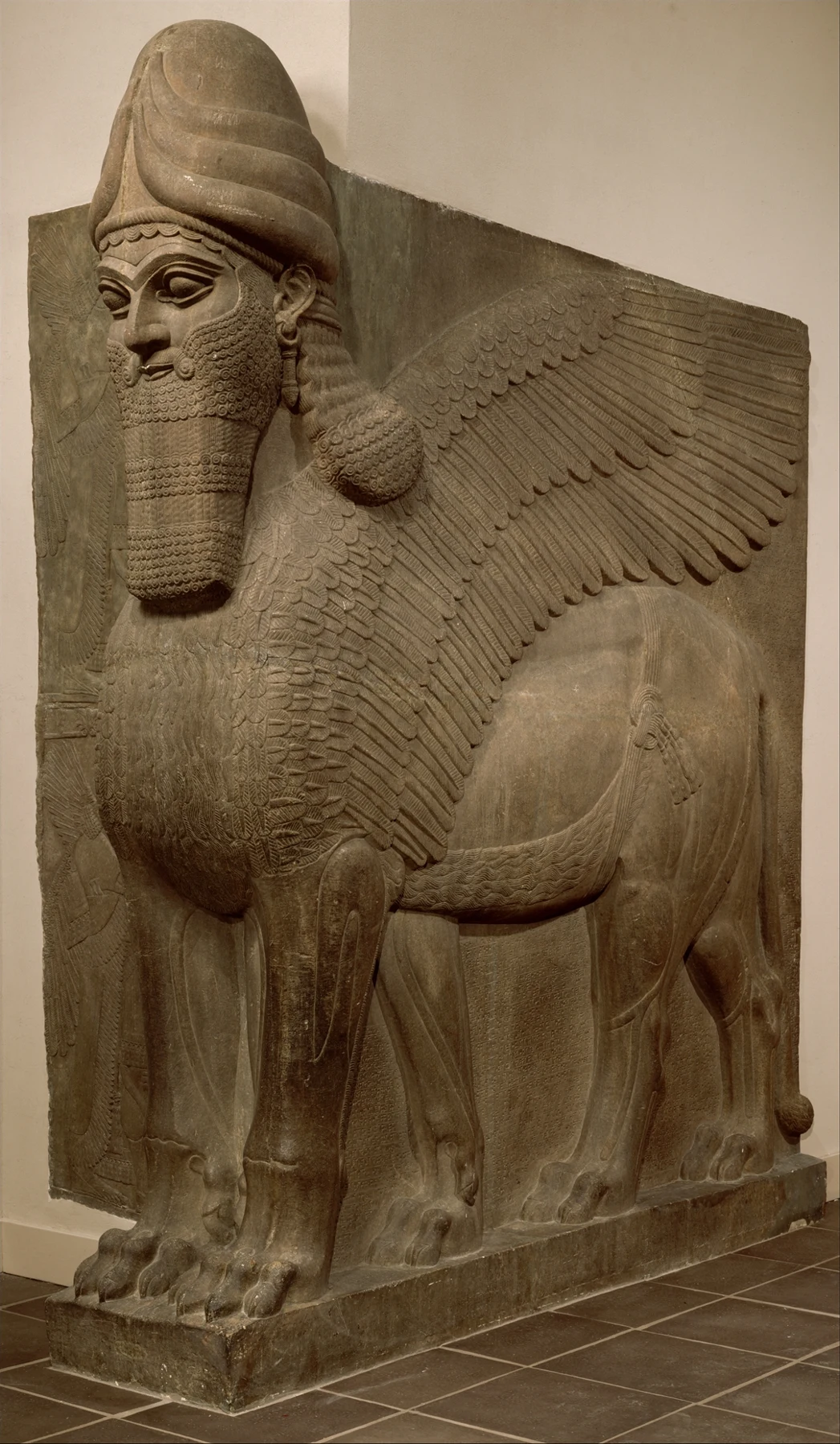
Assyrian lamassu combined a human head with a winged bull or lion body. They stood at important palace entrances as protective figures. The Met's human-headed winged lion from Nimrud dates to approximately 883-859 BCE and is carved from gypsum alabaster.
Why five legs?
Some monumental examples have five legs. Seen from the front they appear firmly planted; seen from the side they seem to stride. This solution responds to a visitor moving past a doorway. It is a useful reminder to read monumental sculpture through viewpoint and architecture.
Ancient object, contemporary meaning
A lamassu may now function as a cultural emblem, an artistic reference or an image of heritage. Those contemporary uses deserve documentation in their own right. They should be distinguished from what an individual ancient sculpture's context supports. The photographs in this archive identify the actual museum object and its licence.
A guardian experienced from two directions
Assyrian monumental guardians combine a human head, wings and the body of a powerful animal, usually a bull or lion. At palace entrances, their composite form marked a protected transition into royal space. Their scale and position were part of their effect.
Many examples have five legs. From the front the creature appears firmly standing; from the side it appears to stride. The sculptor accommodated two viewpoints rather than depicting an ordinary animal. A visitor's movement through the doorway was therefore part of how the work was experienced.
Stone, labour and religious protection
Quarrying, transporting, carving and installing a huge stone guardian required organised labour. Some examples also carry inscriptions, joining a physical presence with written royal statements. The object is evidence of resources and craft skills as well as protective imagery.
Protective beings and the terminology associated with them have a longer Mesopotamian history. The giant winged palace figures should not be equated with every earlier image called by a related name. The origin, date and architectural position of an individual sculpture provide a stronger explanation than a claim that all guardians had one unchanging form.
This introduction draws on the following sources: [1][2][3]. Section reading trails highlight selected references where a more precise relationship has been recorded. Unmapped passages and other references remain at article level; these trails are not a sentence-by-sentence verification. Editorial guidance is identified in the text.
Sources & further reading
- 1Museum object record
Human-headed winged lion (lamassu), 32.143.2
The Metropolitan Museum of Art
Public resource; check individual reuse terms. Recorded source check: 2026-10-26. - 2Institutional collection
Human-headed winged bull (lamassu)
The Metropolitan Museum of Art
Public resource; check individual reuse terms. Recorded source check: 2026-10-26. - 3Preserved encyclopaedia reference
Lamassu
Wikipedia contributors
Full text retained locally under CC BY-SA 4.0. Recorded source check: 2026-10-25. Read retained copy
A foundation to build on
This introduction was compiled from the linked sources and has not received specialist peer review. It is intended as a route into further research. Read how corrections and reviews are handled.
Prepare a correction or contribution